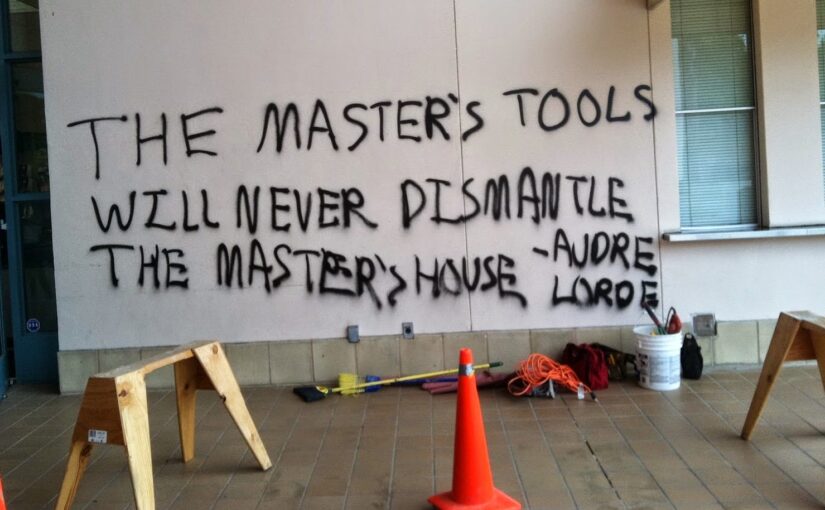
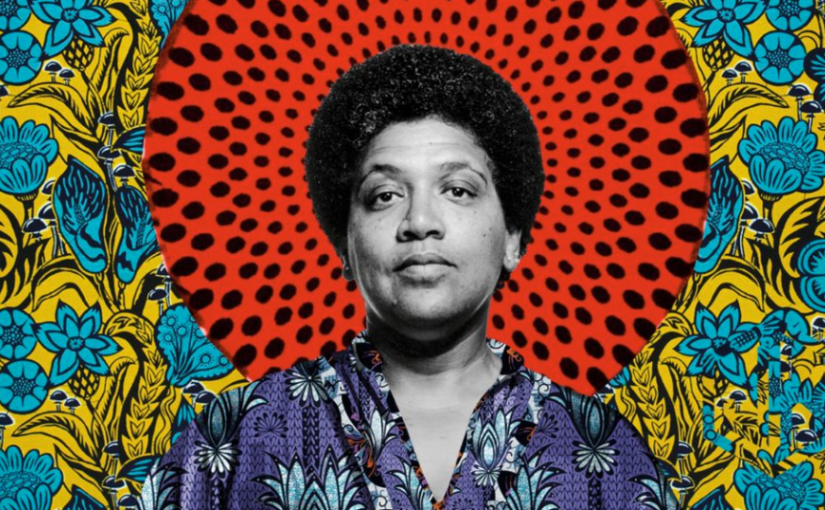
In her essay, The Master’s Tools Will Never Dismantle the Master’s House, Audre Lorde protests the division and separation between feminists in an academic environment. This division of women and overlooking of other women (such as black, lesbian, poor, and third-world women) is being disguised as unity and inclusion.
Lorde challenges white feminists’ agenda of advocating for tolerance. She explains that playing by patriarchal rules of racism and trying to tolerate the difference between women, suggests that these differences are a form of weakness, instead of viewing them as a source of power. Lorde then states that playing by the rules of patriarchy while trying to make change occur, will mean making very little change and staying in the field of patriarchy.
I agree with Lorde’s message that women are “taught either to ignore our differences, or to view them as causes for separation”, playing by the rules dictated by racism, homophobia, and sexism. I also agree with Lorde’s call to come together because “Without community there is no liberation”.
Therefore, I do stand by Lorde’s statement of “the master’s tools will never dismantle the master’s house.” In order to bring about actual change that fights the forces of patriarchy, we all must play by the rules of feminism. We need to be inclusive and see our differences as a fund of creativity and voices.
However, I disagree with Lorde is when she states that the fact we cannot bring about actual change under patriarchy “is only threatening to those women who still define the master’s house as their only source of support.” I believe this is threatening all of us – those who proudly call themselves feminists, those who do not yet believe in equality, the white, black, and other feminists of us – we all suffer from the burden and limitations of patriarchy and the difficulty to bring about change, regardless to our acceptance of patriarchy or not.
Furthermore, Lorde calls on white feminists to educate themselves and not rely on the patriarchal rule where “Women of today are still being called upon to stretch across the gap of male ignorance and to educated men as to our existence and our needs. This is an old and primary tool of all oppressors to keep the oppressed occupied with the master’s concerns.” I stand by the call for self-education and agree that it is not the black feminist’s role to educate others, but to live by her ideology and fight for the racial and gender equality she deserves. Yet, I know that in order to include as many people as possible in your agenda, one must educate everyone around them. Change is not led by one person, one group, or one idea – it is the sum of joint efforts, minds, and forces that creates actual change. Therefore, we must continue and educate the people around us, demand their self-education, and not give room for ignorance.