“Street Harassment” article, RAINN, Rape, Abuse & Incest National Network. https://www.rainn.org/articles/street-harassment
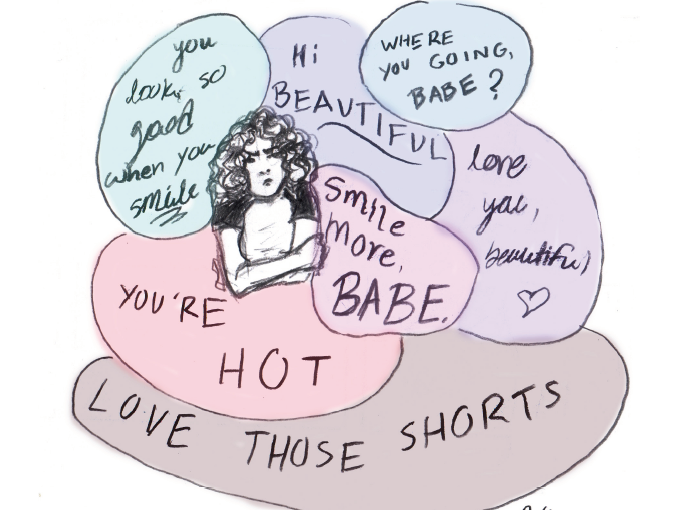
This article details the unwanted behaviors that are included under the umbrella of street harassment. It explains the effects of street harassment on different issues such as human rights, communities, and financial effects, and provides methods of action or interference for victims and bystanders of street harassment. This article helped me gather information about the different unwanted behaviors victim of street harassment face. This was useful for my project when I was looking to for examples of such behaviors that I will present in a cinematic way.
This article from RAINN is reliable and credible by academic standards because RAINN is the nation’s largest anti-sexual violence organization. RAINN created and operates the National Sexual Assault Hotline in partnership with more than 1,000 local sexual assault service providers across the country and operates the DoD Safe Helpline for the Department of Defense. RAINN also carries out programs to prevent sexual violence, help survivors, and ensure that perpetrators are brought to justice.
“RESPONDING WHEN YOU’RE STREET HARASSED” article, Hollaback!. https://www.ihollaback.org/responding-to-harassers/
This article educates its readers on the different methods available to confront street harassers. In my creative project, I was looking for a way in which the protagonist of my short film will be able to confront the catcaller she faces on a daily basis. The three steps guide by Hollaback! (trust your instincts, reclaim your space, and practice resilience), provided me with the emotional character development I needed in order to create the protagonist’s character arc.
This article from Hollaback! is reliable and credible by academic standards because Hollaback! is a global movement that aims to end harassment and change the culture that makes harassment acceptable. This organization works in several ways such as collecting and sharing stories of harassment, training individuals and organizations to respond to, intervene in, and heal from harassment, and growing and developing leaders inside the larger movement to end harassment.
“Creative Responses” article, Stop Street Harassment (SSH), https://stopstreetharassment.org/strategies/creative/
This article provides actual documentation of women’s creative responses to street harassment. This source was useful when I was looking to incorporate a creative response to catcalling in my script.
This article from Stop Street Harassment is reliable and credible by academic standards because Stop Street Harassment (SSH) is a nonprofit organization dedicated to documenting and ending gender-based street harassment worldwide. This nonprofit organization operates a national street harassment hotline, offers online resources for public education, contributes academic articles and books about the topic of street harassment, and researches and collects data from surveying the topic.
Arveda Kissling, Elizabeth, “The Language of Sexual Terrorism“, Discourse & Society, 1991, Vol. 2, No. 4, SPECIAL ISSUE: Women Speaking from Silence (1991), pp. 451-460, Sage Publications, Ltd.
This essay analyzes the social meanings of men’s public harassment of women unknown to them. The essay considers various interpretations of street harassment such as invasion of privacy, the social functions of harassment, and how these functions produce an environment of sexual terrorism. The essay also includes a discussion of the importance of women naming their experiences of street harassment and suggestions for future communication research on the topic. This essay offered my topic a broader perspective on the effects of street harassment on women, the social environment that allows it to exist, and the importance of naming catcalling and empowering women through telling their experiences of it.
This essay is reliable and credible by academic standards because it was written by Elizabeth A Kissling, a scholar of gender, women’s, and sexuality studies at Eastern Washington University. Furthermore, this essay was published in the bimonthly peer-reviewed academic journal, Discourse & Society.
Brookbank, Elizabeth, “Talking Back: Women in NYC confront street harassment“, Off Our Backs, September-October 2002, Vol. 32, No. 9/10, pp. 20-24, Off Our Backs, Inc.
In this essay, an activist from the action group Stop Street Harassment is interviewed. She shares the history of the organization, its work in creating a community for women fighting against catcalling, their creative work through theater, and educating cards on the topic of street harassment. She also offers her point of view on the topic. She explains that street harassment is only part of the mechanism of misogyny and sexism. This essay helped me frame my understanding that street harassment is only one component of sexual harassment. These are the violent everyday examples that are reflected through society’s public spaces. This is the effect and not the cause, of misogyny, sexism, and patriarchy. With this understanding, I saw the value of addressing the topic of catcalling through the medium of cinema which can reach larger audiences and make a more personal impact on the viewer.
This essay is reliable and credible by academic standards because it was published in the women’s newsjournal Off Our Backs, an American radical feminist periodical that ran from 1970 to 2008. This newsjournal was supported by a nonprofit organization of the same name.