Posts

Post 3: Gender, Identity, and Intersectionality

We get to choose our identities by deciding who we really are, and this can often change as we go through our various life cycles. As a child, our identities are often chosen for us by our families, culture and community, but as we age, we can choose to be who we believe we truly are. We can decide our careers, our sexual orientation or our political affiliation. There are many aspects of ourselves that we can choose that will make us more satisfied with ourselves.

Our identity can be chosen for us by our family, community, television, social media and other external sources. We are often told who we are or should be at an early age, for instance, I am a black female. In Trinidad, where I migrated from, I was part of the majority race as Trinidad comprises almost forty-seven per cent of black people, however, part of my identity in American is a minority.  

Our identities can be by social groups we become expose to throughout our lifetime. These groups include families, religious institutions, schools or political organizations. Some of these groups have more influence in choosing a person’s identity than others. Religious institutions usually exert significant power, sometimes dictating what a person should wear, eat or how to conduct oneself.

Some attributes/behaviors are certainly managed or directed more than others. The government defines who we are, our sex, our class and our various statuses like divorced, immigrant or disabled. Depending on our identities or attributes, the government decides which citizens need help and who are not eligible for assistance. In religious groups, those who are more spiritual or follow all the rules are given high positions for identifying and upholding the religion’s identity. Some people may identify heavily by their jobs, such as doctor or congressman.
Your Identity

The ways you get to choose your identity are extensive, everyone is different and their own person, our environment and beliefs shape our identity. We know who we are or get to know who we are. As you are exposed to different things you will continue to find yourself. You may choose to be any way you want to be. The ways it is chosen for you is by societal standards and sometimes your parents will shape your identity in the act<zaivities they have you participate in as a child.

The trends I notice are that many times people parents try to decide what aspects and what kids do to shape their personality. For example, when someones will say I want my child to do a certain sport or activity that helps to shape someone’s identity. Other parts of your identity/behavior is also learned at home, children act as they see so good or “bad” behavior is learned from parents and other family members.

Your Identity pertains to all parts of you from the things you like to what you dislike. It also has to do with what yoou’ve been taught/have learned and your morals.

Gender, Identity and Intersectionality

By: Shai Hutchinson

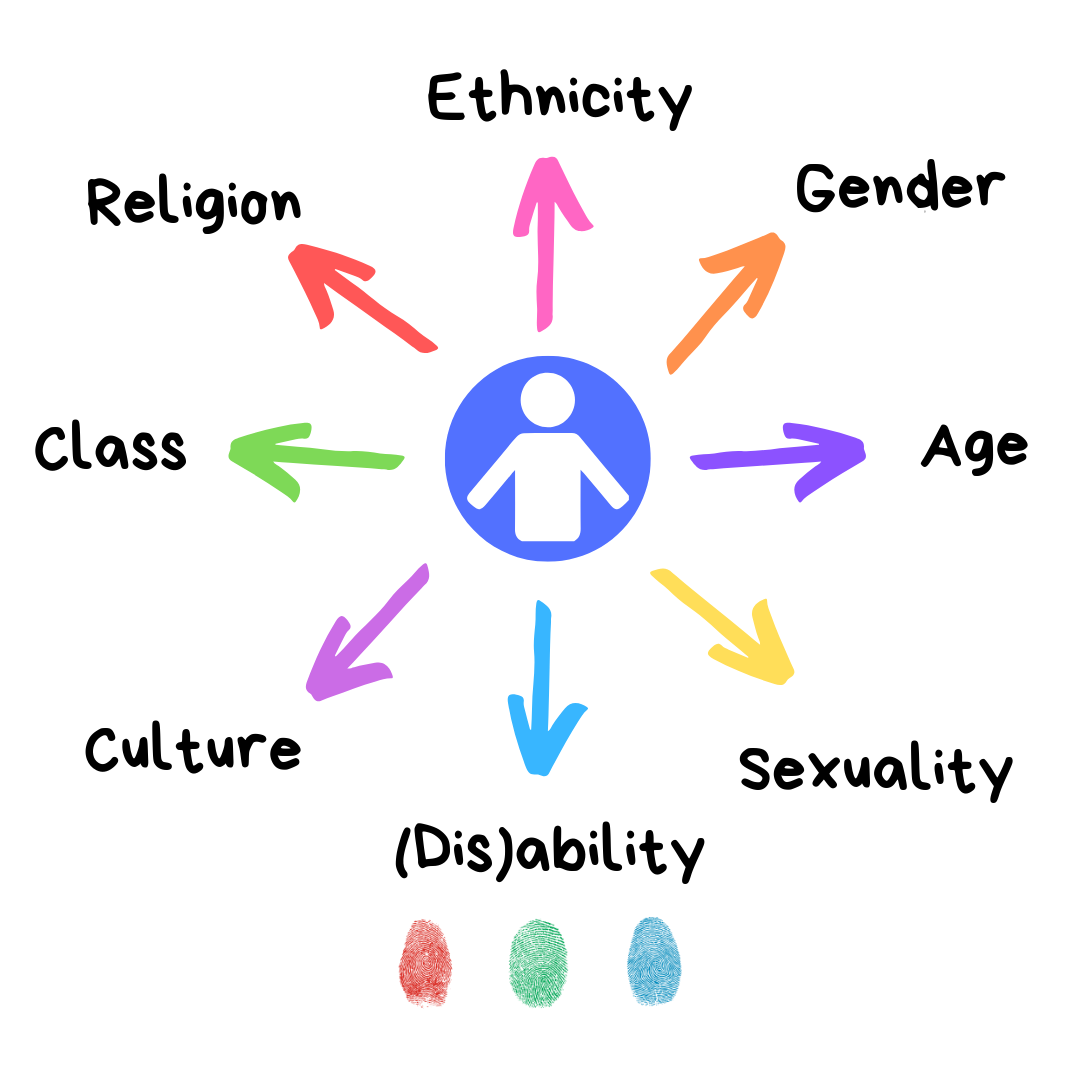
Identity beyond Disability. Intersectional Approaches to Disability | by  Diversity & Ability | DnA's Blog | Medium

In my opinion, gender, identity and Intersectionality all overlap under the same umbrella of the requirements of social expectation. Identity falls under the broad spectrum as what we all see ourselves, while gender also falls under identity, where we are not necessarily the gender that society expects us to be, but what we identify ourselves to be. Intersectionality in itself takes all these aspects of our identity to qualitatively illustrate how these identities create an overlapping system of discrimination, while also allowing us to see the extent of our differences in the basis of identity. We each hold so many identities that our individual identities can sometimes overlap to form commonalities with the identities of others. In these situations, the majority of the commonalities might sometimes be more favored in society, forming discrimination against the less common groups. The individuals that hold certain identities that are not shared by many other people are sometimes disgracefully isolated from society. This is one of the worst ways in which our society can disappoint us. We should all be allowed to express our identities freely and comfortably without the fear of being judged by other groups who live with the notion that the majority should be the norm of society.

We choose our identities by the way we see ourselves from certain aspects of our characteristics and the decisions we make in our daily lives. For example, gender, political affiliations, religion, race, sexual orientation, disability, nationality, education, language, occupation, ethnicity, social class and marital status are all ways in which we identify ourselves. These categories are often used as forms of discrimination in society. To prevent the less common identities, some of these are often chosen for us. For example, from birth, our genders are chosen by our parents who choose the gender based on our given sex. These genders are assigned based on what is more common and supported in society. For example, in fear of discrimination, many little boys who feel the desire to wear dresses and nail-polish, identifying as the opposite gender, are forbidden to do so by their parents.

Furthermore, in many cultures, marital status are often chosen for young men and women by their parents, before they even become adults, due to the fact that being married is a more favorable identity to obtain in these particular cultures. The trend I see many times in who decides aspects of our identity are not us, but our parents. Our parents assign us preferable identities in order to have us be a better fit in society, but they do it out of love and fear of us being discriminated, due to less common or favorable identities that we might want to express. However, we should all just be who we want to be regardless of what society thinks is more preferable or “normal.” There is no such thing as “normal,” regardless or where our individual identities lead us in the framework of intersectionality.

Post 3

We get to choose our identities based on the options given to us by society. Most of these choices are predetermined and chosen for you in a way. In modern days, identities are more open to discussion and thus, there are more identities to be classified as. The trend seems to decided by society and what is expected in those times. Most identities involving gender tend to be managed more as the topic is extremely controversial.

Identity

The way in which I choose my identity is by staying true to myself in my beliefs and thoughts, I choose my identity and do not follow what others expect me to follow simply because visually I am a woman so therefore I will be a wife and have kids. I choose my identity by believing in myself and doing what makes me comfortable. I do not want to follow the traditional roles that limit many people and are toxic in many cultures. The way it was chosen for me is that when I was younger other girls would make me feel less feminine if I dressed differently than the typical girly dresses or skirts, and I would see this in television too when the tomboy gets the makeover and now the boys pay attention to her. Another way is that men will tell me I will have to tend to both kids and a husband while the husband does nothing because “he is the breadwinner” which ultimately made me refuse to learn to cook as a way to rebel against that ideology because I feared becoming that stereotype that I often see around me. I noticed that the trend in who gets to decide the aspects are men because they’ve been in a spot of privilege since the beginning of time. I think all of these behaviors have been directed time and time again by many different cultures and social statuses by men because it can be hard to escape a behavior that is so accepted in society that favors one side more than the others.

Post 3: Identity

     You can discover your own identity and others may be able to help you with that. But other people cannot give it to you completely unless you give them permission to do so. However, even then are not really “you”, but just the idea these others have made of you, so I think that truly only you can choose the identity, because other people cannot know you better then you can. Also, this question is complex because I believe that it all depends on the culture, environment, era, and your parents, of course.

Also, I believe that identity is both given and created, because your given identity pre-exists and any identity you create for yourself is structured upon those that were given. You can create your identity with the actions you make. There are so many factors that also create your identity which I mentioned above – you family, the community you grew in, environment, your friends, social media influence, what you like and what you don’t like etc.

Gender, Identity, and Intersectionality

After completing the identity chart, I had an important insight — how others see us depends on certain norms and stereotypes that are common in society at this time. For example, a woman may be married to a man, and others would consider her heterosexual, while she would identify herself as bisexual. Or some would see a dark-skinned person and assume their race and nationality right away. Or a person could be in a bad mood that day, and those who interacted with that individual just once would forever remember them as bad-tempered. Thus, all of the aspects of our personalities could be interpreted by people in various ways. But it’s only us who know ourselves better than anybody else, and we should stick to this knowledge and our inner feelings. To speak the truth, all of us are guilty of unconsciously labeling each other, and it’s just how the human brain works. 

Some attributes and behaviors are considered more traditional, therefore, they are more acceptable. For instance, the traditional image of a woman is a man’s wife, child-raiser, homemaker, and well-mannered lady. The traditional image of a man is a strong leader, bread-winner, aggressive warrior. Those entrenched patriarchal standards dictate rules for behavior, identification, and ethics. Every deep-rooted stereotype prevents people from identifying themselves freely and should be disposed of.

Gender, Identity, and Intersectionality

My culture plays a role in how a person’s identity is formed. Aside from the good that is found in my culture, there are many factors that can either make you a slave to society or your own person. One factor that plays a role in my identity is my gender. Gender roles in my culture have been passed down through generations. You are identified by the way you are as a woman in society. A woman is required to cook, clean, and raise children, whereas, men are required to work outside to provide their family with the necessities they need in order to live a stable life. However, these gender roles have been slowly breaking down in terms of young women gaining their education, working and building themselves up for their own future. In my culture, there is no sense of individuality. You are who you hang out with and you are perceived based on the personality of those you surround yourself with and the way you act. Even your own family’s actions can either come against you or support you for future purposes. My culture is very focused on judgement. However, recent generations have been breaking all these ‘rules’ that have been set out over time. 

Gender, Identity and Intersectionality

Some of the categories we use to create identities include: gender, sexuality, race, age, religion, expressions, personality, body shape, nationality, ethnicity, socioeconomic status. All these different categories create an individual identities. Gender identity is one of the important things to identify for an individual. Each individual has a different personality . People have different personalities because of their surroundings by growing up and how they have seen society as a whole through culture and traditions. I think as by age personality changes significantly and it also depends what kind of social structure you are surrounding oneself in and through the environment. Gender is more than just a difference of biological, social, cultural difference. It is how we perceive ideas and thoughts and filter the world around us. For most of modernity, gender has reinforced patriarchy and allowed for huge inequities to take place. Gender roles and expectations are not the only way they interact with how people live and experience and navigate this world. The question of defining gender means speaking about gender in relation to sex. In my perspectives gender and sex are two different definitions. Gender has no one particular definition, but it is something that has been constructed across societies and through cultural definitions rather than pure biology. Identities define means to me who I am, what country I am from, how people view, perceive and develop characteristics that tell about me. 

Life is not only about learning, receiving an education, marriage, having a family, earning income and death. There are much bigger reasons that we are here as human beings. We can’t all be the richest person in the world or a philanthropist in the world. Life’s important meaning as a human being is what we can do for others even though it’s a very small step. Identifying yourself sounds very easy, but it’s not. I believe that no matter whether religiously, spiritually, or culturally I am different from others and my purpose of life is to be as a human being who I am and what I’m doing for others. No matter how hard my journey of life I always put others’ problems first to solve at least a little.However, I changed so many people’s lives and am always in the process of doing something that can change others’ life easily. When it comes as an identity, people always say that I am kind, thoughtful, generous,helpful, caring,supportive  and dedicated to others.

Intersectionality, a term created by legal scholar Kimberle Crenshaw in 1989, the Oxford Dictionary defines intersectionality as “the interconnected nature of social categorizations such as race, class, and gender, regarded as creating overlapping and interdependent systems of discrimination or disadvantage”. Intersectionality helps to define my own experiences as a Bangladeshi woman, a mother, a first generation immigrant and someone who has had to defy glass ceilings put on me through the communities I belong to in Brooklyn and in Bangladesh. I have a beginning, but no end. It constantly evolves and with my lived experiences allow for it to be realized in how my intersections of this world are constantly shape shifting.