Elizabeth Moore, Mandy. “Future Visions: Queer Utopia in Steven Universe.” Research on Diversity in Youth Literature: Vol. 2: Iss. 1, Article 5. Jun 2019,
https://sophia.stkate.edu/cgi/viewcontent.cgi?article=1069&context=rdyl
When queerness exists in children’s shows, many are quick to say the content is extremely adult for children. This article examines the links between children and queerness. Even sexuality is seen as something meant for adults and not for children. The show imagines a queer future that includes “love, acceptance, and playful fluidity”. The article mentions how the show doesn’t address the violence of colonization. It shoots for inclusivity when depicting characters, yet highlights white queerness instead. Fusion is to be used only for fighting purposes according to the diamonds. Fusion is clearly queer and intimate. Garnet is a healthy relationship between two gems from different classes. The Diamonds exist as colonizers and oppressors.
Brammer, J.P. “Steven Universe Is the Queerest Animated Show on TV.” Vulture, 30 Jan 2017,
https://www.vulture.com/2017/01/steven-universe-the-queerest-cartoon-on-tv.html
This article mentions an episode where Pearl has a crush on a girl. The audience is able to distinguish that this is the first queer human character in the show. Prior to this, most queer implications are subtle and never directly addressed. The show doesn’t focus on gender and sexuality as concepts, it ignores them entirely. Steven Universe completely ignores the gender binary as an idea. The gems are genderless aliens, while Steven is half human and half gem. Steven defies the male gender expectations in everything he does. Steven is sensitive and unafraid to embrace his feminine qualities. Steven’s powers are not fixed in anger like most male animated characters with powers. Fusion is when two characters dance and combine into one character. The show suggests this is a romantic act. Garnet remains fused at all times because Ruby and Sapphire enjoy being fused as Garnet.
Cao, Caroline. “‘Steven Universe’: 5 Ways This Kids Show Was Queer Before Its Lesbian Kiss.” IndieWire, 13 Jul 2018,
https://www.indiewire.com/2018/07/steven-universe-queer-rebecca-sugar-1201983866/
The show steers away from heteronormative expectations. Fusion allows a character to be larger and more powerful; this can occur during toxic fusions. Fusion alludes to emotional associations with other people; it also informs viewers about consent and relationships. Fusion is a forbidden act on the gem’s home planet. It also mentions how Steven Universe addresses, pansexuality, polyamory, and nonbinary characters. When Lapis and Jasper separate after being fused they realize how emotionally fixed they’ve become to each other. This is an example of a toxic relationship. Even one character, Fluorite is a depiction of a polyamorous relationship. Fluorite is a fusion made up of six gems. This show illustrates a world without binaries and cisnormativity.
Halberstam, Jack. The Queer Art of Failure. Durham: Duke University Press, 2011. Print.
Halberstam utilizes low theory which “runs the risk of not being taken seriously”. It encourages failing by searching for ways to defy heteronormativity and capitalism. It challenges the ideas of heteronormativity and capitalism. Halberstam examines complicity and individualism. The book discusses how failure can be a process of growing in a positive way. It uses references from animated films and tv shows. It pushes readers to think about concepts in a non-normative way. Steven Universe encourages revolt just as Halberstam discusses in Chapter 1. Childhood is a time when children are “queer in nature but society trains children to be heterosexual”. Children are taught the idea of marriage and reproduction. Just as Halberstam suggests, animated films are about characters rebelling and Steven Universe is about revolution as well. The characters in Steven Universe disrupt conventional ideas of romance, gender, and sexuality.
“Alone Together.” Steven Universe, season 1, episode 37, Cartoon Network, 15 Jan. 2015. HBO
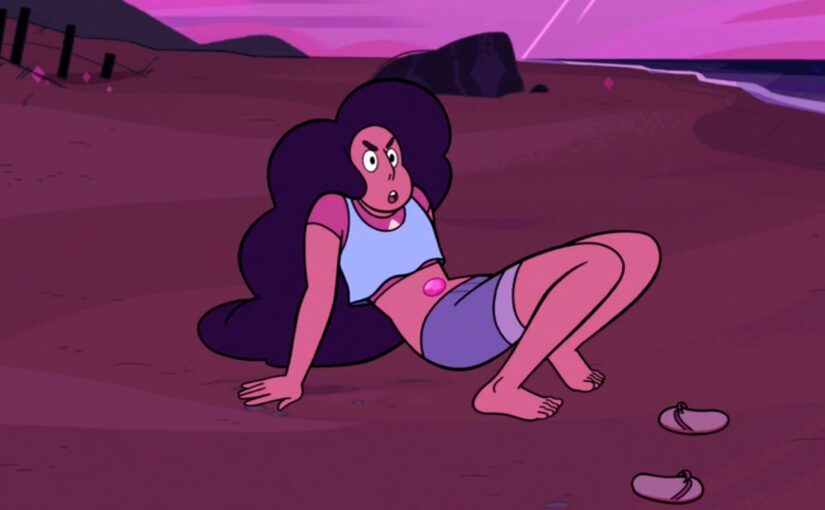
This is an episode from Steven Universe that I will be using to influence my project. Pearl thinks Steven isn’t old enough to start fusing and thinks it is improper when she sees Stevonnie. Meanwhile, Garnet believes in Steven and encourages him to try. Once they fuse, Garnet tells them to have fun and to see fusion as an experience. Steven and Connie are dancing in this episode when they accidentally fuse together. This is Steven’s first time fusing. This is a clear depiction of someone who is genderqueer. Stevonnie uses they/them pronouns. Both men and women find androgynous Stevonnie attractive. A nonbinary person does not need to be androgynous to identify as nonbinary.

