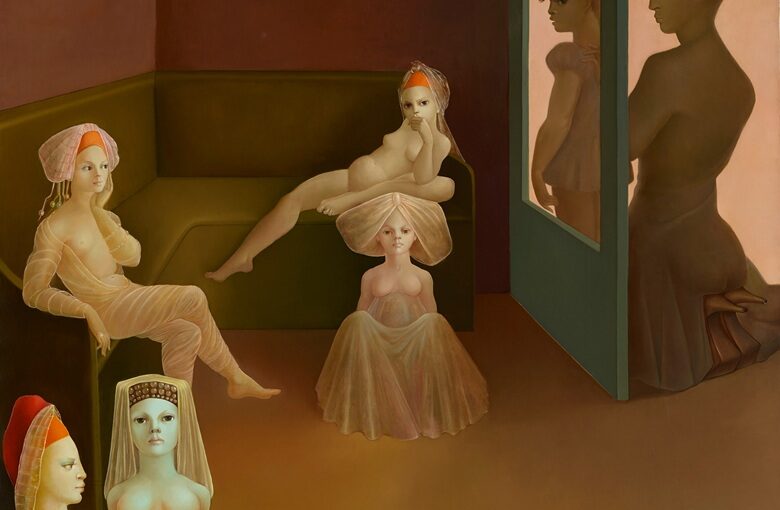
The idea of hysteria manifesting itself through a woman as a spectacle for men is a prominent point made by Hélène Cixous and Catherine Clément in The Newly Born Woman. I wanted to write a script for this project because the idea of spectacle made for and by the male gaze is inherent not only in hysteria, but in the DNA of film and feminist film studies. Laura Mulvey addresses the woman as spectacle in her essay “Visual Pleasure and Narrative Cinema”, and identifies the value of a woman’s appearance as her to-be-looked-at-ness. The emphasis on a woman’s appearance in relation to her overall value is the omnipresent oppressor in our patriarchal society, one in which the hetero eurocentretic capitalistic male gaze is the definer of criteria. The purpose of a woman is essentially to be desirable enough to be a viable commodity and if they’re not they have no business being seen. “With the circus and the cinema, we have moved into the institutionalization of hysteria: spectacle cashing in on the exchange of money” (Cixous p.13). This statement perfectly illustrates the environmental conditions of patriarchy, capitalism, and institutions that are needed in order to serve as a stage and catalyst for hysteria to manifest because hysteria does not surface without the presence of bondage or spectatorship.
In most of the films (Possession by Zulawski, The Brood by Cronenberg, Repulsion by Polanski) that I watched by male directors that depicted hysteria – the woman almost always serves as a manic spectacle while still maintaining a level of attractiveness for the male spectator or else there would be no reason for the male to watch or endure the emotional distress present in the situation. What usually sparks the episode of hysteria is infidelity (or any sexual act-or lack thereof) or some form of transgression against prescribed gender roles. The woman simply exists and only becomes the hysteric once the man steps in and identifies a “problem” which is usually some unexplainable force (such as an undiagnosed mental illness or paranormal entity) that controls her and causes her to undermine him as her superior and owner. In doing this, the agency is taken from the woman, but the blame is still posited on her instead of on the society in which she resides. We only see what she has done and not what she has endured.
This of course isn’t always the case as there have been emotionally intelligent depictions of hysteria and mental illness portrayed by men… or rather one man – John Cassavetes with the collaboration of his wife Gena Rowlands. His female characters exhibiting signs of hysteria are usually cracking under the pressure of gender roles and expectations. The female characters even when experiencing near psychosis are desperately attempting to regain themselves. We can always see them thinking. They have objective and purpose. Everything is done as if their lives depend on it. Another thing he does is he flips the camera towards the spectator while the spectacle is happening. In A Woman Under The Influence he focuses on the reactions of the partygoers exiting the party who watch Gena Rowlands bizarrely dance on the couch after her return from treatment. In Love Streams, Gena Rowlands’ character desperately attempts to make her daughter and ex husband laugh to no avail. Instead of us watching her we watch the ex husband and daughter as she slips in and out of frame. Cassavetes also doesn’t leave hysteria just for women. The male characters in his films can often be seen as hysteric and his character in Elaine May’s Mikey and Nicky is a true hysteric.
I chose to write a silent film because I didn’t want to explain what was happening to the protagonist, but rather have the viewer experience what she experiences and feels. Cixous and Clément emphasize fragmented memories and relation to youth. In my film the protagonist is caught in an obsessive recounting of memories and images from her youth intertwined with nightmares of her current situation and future. The emphasis here is still placed on appearance and aging because unfortunately those are the ever present criteria in which we are being appraised. It’s not that the psychosomatic symptoms of hysteria presented in film are always wrong, but it’s the fact that the cause is often absent and we are watching the “hysteric” through a male’s eyes. It’s about his perception and not hers. My script on the other hand is about her perception.

