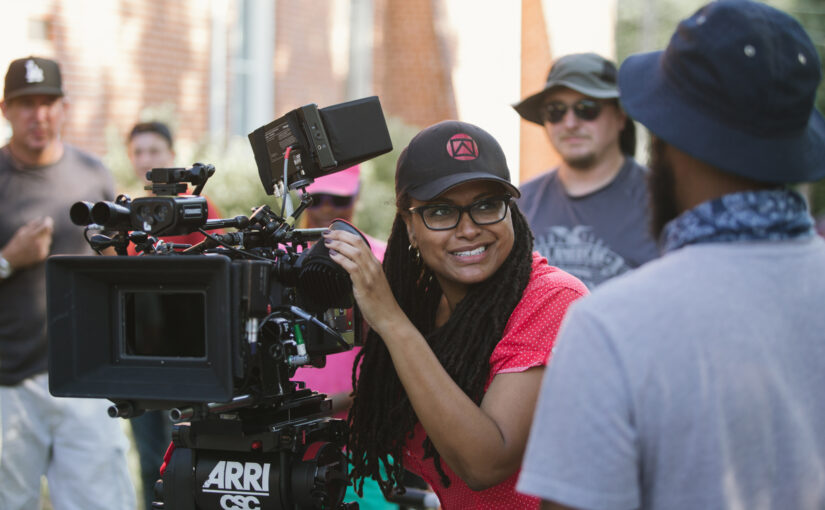
Buckley, Cara. “More Women Than Ever Are Directing Major Films, Study Says.” The New York Times, The New York Times, 2 Jan. 2020, www.nytimes.com/2020/01/02/movies/women-directors-hollywood.html?smid=url-share.
- This article written by the New York Times is informative on the changes that are recently changing slowly. It uses statistics on the number of female directors that were made in 2019, and the percentage of movies that were made from 2007 to 2019 that were led by female directors. It also discusses how much is progress when it was near little to none in the number of women as directors. Specifically, 12 out of the top 100 movies of 2019 were directed by women, which believe it or not is an all time high. These statistics demonstrate how far we have gone but it also highlights how much left we have to go.
Erbland, Kate. “Chloé Zhao, Emerald Fennell Make Oscars History as Two Women Nominated for Best Director.” IndieWire, IndieWire, 15 March 2021. www.indiewire.com/2021/03/female-directors-nominated-oscars-chloe-zhao-emerald-fennell-1234622741/.
- This article by the IndieWire highlights the big yet sad progress that women have achieved in terms of representation. This year’s Oscars has nominated two women for its directing category for the first time in its existence since it started in 1927, almost 100 years. It is a big achievement because usually there would be no female directors or maybe just one in the category. This gives hope to future female filmmakers in changing the numbers but it also signifies that there is still no promise that it would be more fair to get our movies made with the same attention as a movie made by men. Hopefully, one day there will be only women in the category like there are only men today.
Mahar, Karen Ward. Women Filmmakers in Early Hollywood, Johns Hopkins University Press, 2008. ProQuest Ebook Central, https://ebookcentral.proquest.com/lib/brooklyn-ebook/detail.action?docID=4398415.
- This source by the author Karen Mahar discusses how much we are not taught about the role of women on sets in the early years of film and filmmaking. We learn that actually women were initially accepted as filmmakers and were a prominent role in front and behind the scenes. But, once the 20s came along that behavior started to change to favor men over women instead of having an open field of equal opportunity. We see how the film industry began to show sexist behaviors that set back the progress that was on place when it started and how women started from square one again but are not at the position they were once at because of the system and organizations that excluded women.
Silverstein, Melissa. In Her Voice : Women Directors Talk Directing, Open Road Distribution, 2015. ProQuest Ebook Central, https://ebookcentral.proquest.com/lib/brooklyn-ebooks/detail.action?docID=2146024.
- This source by the author Melissa Silverstein discusses with multiple well established women filmmakers the experience of how to bring their visions to life and the struggles that come along in making them. The women in the book talk about their process of how being a woman can sometimes make their voices less amplified than the voice of the men that feel entitled to take over their own stories. It also dives into the discussion of how certain movies really can’t be made by men because they simply do not understand the perspectives of women that go through certain experiences.
Woerner, Meredith. “Olivia Wilde and Emerald Fennell on Banning A-Holes and ‘Are You Sure?’ From Movie Sets.” Variety, Variety, Feb. 2021, variety.com/2021/film/news/olivia-wilde-booksmart-emerald-fennell-promising-young-woman-1234900528/.
This interview is by Variety between two professional and acclaimed directors, Olivia Wilde and Emerald Fennell, who has been working in the film industry for many years and knows what it is like first hand both in front and behind the cameras. This interview empowers women as filmmakers because although they are aware they are seen as replaceable by higher people, they don’t let it limit them from standing up for themselves and others around them. The two women discuss the no A-holes policy they follow on sets when they are directing because they want to create a safe and creative environment that allows their talent and crew to thrive together in making their film. We hear many horror stories about movie sets with toxic and sexist people in charge that it is inspiring to see women take their stand in not allowing or rewarding behavior that can ruin a set or project for others.

