Posts

The Masters Tools and House

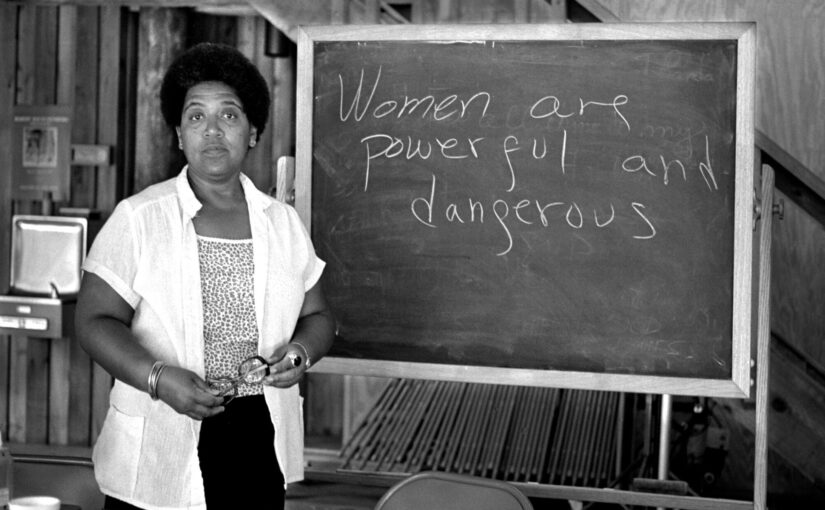
The Masters Tools Will Never Dismantle the Masters House is a poem by Audre Lorde. Lorde is a Black American feminist poet that has strong beliefs towards racism, sexism and homophobia. A discussion of what the poem is about is based on two things that stood out to me. The “masters tools” which is about racism and classism. The “masters house” is a metaphor that speaks around strength and underestimation. The existing power that Audre Lorde speaks of, is the dynamics and hierarchies that abides by committees, institutions and organizations. Women in this society have the power too and can be the masters tools and the masters house.

Feminism, What is it?

  • Last week in class a discussion about what feminism is, occurred. Being a feminist means there is a position that socialites equalizes the sexes. The class discussed what a feminist/feminism is. Feminism is a movement to end sexism, sexist exploitation and oppression.” There were important points in society that associated during the times of this.The first wave, in the 1920’s that felt with the right to vote. The second wave, in the late 1960s-70s that had the white and middle class movement. And the third wave, in the late 1980s-90s with culture wars. During those times it was very difficult hardship in the acts of feminism.

Blog 4: Intersectionality vs. Toxic Masculinity

  • In class last week we learned about two different terms and what those terms means to us. Various words were discussed about Intersectionality and Toxic Masculinity. Intersectionality was defined as what impacts our ability to move in and out through the world. Which is also at stake when humanity-fully realizes its actual self about humanity including a universal design that different to learning. Toxic masculinity was defined within individuals and broader accountability that can be very isolating. Its masculinity and it’s qualities that will be shrunken and more limited in the future.

Blog 2:

Pedagogy vs. Education

After reading Paulo Freire’s Pedagogy of the Oppressed, Chapter 2 talks about its “banking model”. Which is the scope action allowed to the students extends only as far as receiving, filing, and storing the deposits. My experience with the “banking model” of education, I have had several educators who have made deposits on their teachings. I can only remember to intake as much information. Educators expect us, the students to repeat the material that was taught to us. But the educators make sure the information is transparent for us to understand it.

Freire talks about power intersecting with education. Education is thus constantly remade in the praxis. In order to be, it must become. Freire’s reading states an example of problem-posing education. Affirming men and women as beings in the process of becoming as unfinished, uncompleted beings and unfinished in reality. From my own experience to Freire, education has always been made a mode of memorization. In order for us, the people to be something, we must become something.

The Pedagogy attempts to stands for what a person gains and loses. The people gain being more human but lose its power of fighting attempting to the oppressed.

Blog 3: Relationship and its Gender

Gender gap in data
  • My relationship to gender is its connection with others. Discussions, attributions and culture are a big part of the gender culture. The relationship to gender comes up in life in households (family), at work and social gatherings. This gender also is brought up in social media platforms and network of television. Relationship and its gender is a topic we can all talk about but as there are opinions, this topic can become intense.

Scavenger Hunt

This was a very interesting and informative class!!! I’m happy that I was able to take it and it honestly felt like fun and was a nice way of doing an activity throughout online learning. I’m always interested in learning more about how women in gender have to deal with daily struggles and how there are two types of feminism. I also like being able to know what someone else’s view on a certain topic is which is why I really enjoyed this scavenger hunt. I found myself agreeing with each point that my peers made and it made me feel like I was in an actual class (as in not virtually). I will continue to educate myself more of course but this was a great start to learning. Thank you for making this class enjoyable and I hope that you all have a wonderful summer!!!

Asian American Women In Society

Asian American Women in Society

10:30am-12:15pm on Tuesdays/Thursdays

FALL 2022

Professor Islam 

Email: [email protected]

Extension 0613

Brooklyn College

Office hours: Tuesdays (9:00-10:15am) Thursdays (1:00-3:00pm) 

  • Kindly email me in advance to schedule an appointment. Thank you.

For this class, it will be given in a synchronous fashion along with a few asynchronous activities. Details will be given in another section of the syllabus. 

Course Description 

Welcome to Asian American Women in Society! Thank you for taking an interest in wanting to get to know about the struggles that Asian American Women have been facing. In this class, you’ll be learning about how there are certain gender roles whether it be at home or in general. You will also be learning about stereotypes that are placed upon women who come from an Asian household. Also, how AAPI women who associate themselves as being part of the LGBTQ+ community deal with daily struggles.

Course Goals 

Students who complete this course successfully will be able to: 

  • Learn about the importance of how Asian American Women are depicted in television/movies
  • Read articles regarding how to help shed light on the fact that AAPI have been dealing with struggles especially during this time of the pandemic
  • Create a monthly journal entry regarding if they watched or read  anything on the media about how Asian American Women representation is depicted. This should be a minimum of a paragraph (8 sentences)

Class Participation 

<Describe the function of student participation within the course, as well as your expectations for how students should participate in class. This information should include whether participation is required, how it is assessed, etc. 

Consider including a statement indicating that all interactions in class will be civil, respectful, and supportive of an inclusive learning environment for all students. Encourage students to speak to you, the department chair, or an advisor, about any concerns they may have about classroom participation and classroom dynamics.>

Course Grading  

Explanation of Grading System

  • Attendance: 20
  • Paper 1: 15% of total grade or maximum points
  • Paper 2: 15% of total grade or maximum points
  • Exams (1, 2, & 3) 30% (each exam is worth 10%)
  • Class Participation: 20%
  • There will be three exams given throughout the semester where the third exam will be the final exam. These exams will include material that we have studied about throughout the semester such as supplemental readings and notes that you will need to take during classes. The format for the exams will be some multiple choice questions and the majority of it will be short responses. I want to see what everyone’s thoughts are, which is why I’ll be asking questions to see how intuitive you are. There will also be two papers, where one paper will be based off the topics that we’ll be learning about throughout the semester and the second one will be a topic of your choosing as to what you found interesting in this class and how something from either media can tie into this. 
  • I encourage classroom participation since I want to know your takes on these issues and always remember that your opinions always matter. There is no right or wrong answer. Other than that, I hope that I’m able to open your brains in a way in order to be more in know of what’s happening. 

Topics

  1. Asian American women in media
  2. Take on LGBTQ+ women who are Asian American
  3. Gender Roles of Asian American women

Course-Specific Support or Supplementary Instruction

  • Feel free to check out the tutoring center for any help needed with your papers and exams. Also, please don’t hesitate to reach out if you have any  course related questions as long as the questions are not questions that can already be answered from the syllabus.

Course Policies and Information for Students

INCLUSIVE LEARNING ENVIRONMENT STATEMENT

<The following are suggestions of policies that can help ensure your class runs smoothly.. >

  1. ATTENDANCE POLICY
  • Attendance is absolutely mandatory for both sessions. However, if you are unable to attend a session, please email me in advance. I’d prefer it if you are able to get some notes from your fellow classmates in order to catch up with what you have missed. If there is a religious holiday, I’ll be understanding if you are unable to attend my session but please email me in advance again. 
  1. LATE WORK and REQUESTS FOR EXTENSIONS
  • Regarding late work. I’m willing to be lenient as long as you email me to talk about when I could extend your due date. 
  1. POLICIES ON MISSED EXAMS, MAKE-UP EXAMS OR QUIZZES
  • I will only allow make-ups for quizzes under specific circumstances as long as you email me as to why you weren’t able to take the quiz.
  1. ETHICS/VIOLATIONS OF ACADEMIC INTEGRITY: Ethical behavior is an essential component of learning and scholarship. Students are expected to understand, and adhere to, the University’s academic integrity policy: wustl.edu/policies/undergraduate-academic-integrity.html. Students who violate this policy will be referred to the Academic Integrity Policy Committee. Penalties for violating the policy will be determined by the Academic Integrity Policy committee, and can include failure of the assignment, failure of the course, suspension or expulsion from the University. If you have any doubts about what constitutes a violation of the Academic Integrity policy, or any other issue related to academic integrity, please ask your instructor.

Resources for Students

  1. CUNY Policy on Disability Services
  • In order to receive disability-related academic accommodations, students must first be registered with the Center for Student Disability Services. 
  • Students who have a documented disability or suspect they may have a disability are invited to set up an appointment with the Director of the Center for Student Disability Services, Ms. Valerie Stewart-Lovell at 718-951-5538. If you have already registered with the CSDS, please provide me with the course accommodation form and discuss your specific accommodation with me as soon as possible.   
  1. ACCOMMODATIONS BASED UPON SEXUAL ASSAULT: The University is committed to offering reasonable academic accommodations to students who are victims of sexual assault.  Students are eligible for accommodation regardless of whether they seek criminal or disciplinary action.  Depending on the specific nature of the allegation, such measures may include but are not limited to: implementation of a no-contact order, course/classroom assignment changes, and other academic support services and accommodations. The University will maintain as confidential any accommodations or protective measures provided to an individual student so long as it does not impair the ability to provide such measures.
  2. CUNY Policy on Academic Integrity
  • The faculty and administration of Brooklyn College support an environment free from cheating and plagiarism. Each student is responsible for being aware of what constitutes cheating and plagiarism and for avoiding both. The complete text of the CUNY Academic Integrity Policy and the Brooklyn College procedure for implementing that policy can be found at this site: http://www.brooklyn.cuny.edu/bc/policies. If a faculty member suspects a violation of academic integrity and, upon investigation, confirms that violation, or if the student admits that violation, the faculty member MUST report the violation.

MENTAL HEALTH: Mental Health Services’ professional staff members work with students to resolve personal and interpersonal difficulties, many of which can affect the academic experience. Your mental health is a very serious matter so please don’t hesitate to reach out to someone in our facility who can help you. These include conflicts with or worry about friends or family, concerns about eating or drinking patterns, and feelings of anxiety and depression.

Asian American Women (Research Summary)

  • When it comes to Asian American Women, there are several standards that they are told to measure up to, this is starting from the moment that they are born up or even it being in the present time for them. AAPI women have to grow up in a way where they are taught to follow these standards that society would want them to follow. For instance, learning how to make tea (chai) properly, learning how to cook so that in the future you could feed your significant other (they can only think of the other person as being a man), and basically learning all of these principles of how to make a man happy. Families within the AAPI community are in this old fashioned mindset even to this day where they can only think of this idea where their life goal is to make sure that they can pull this “Cinderella” in a way to transform their daughter into someone who will one day marry a guy. After their daughter is married off, they will feel content that they were able to make them into the person they are today and society will be happy with them since they are doing what society wants them to do. 
  • In today’s society, families (this is in other communities as well but I want to focus on the AAPI side) can’t think of the fact that there are people who exist who are part of the LGBTQ+ community. According to them, if they were to have a daughter who associates themselves as being part of that community, the first thought that they will go through is what will people say. The article that I chose is this essay called “‘Brown girls can’t be gay:’ Racism experienced by queer South Asian women in the Toronto LGBTQ+ community.” This article focuses on this idea of how South Asian women are discriminated against due to how they associate themselves as being part of the LGBTQ+ community. South Asian women are basically supposed to be trying to bring honor to their family in a sense, so if they were to say that they didn’t want to have a heterosexual marriage then it would be the equivalent to them bringing “shame” to their family which shouldn’t be the case. Sadly, what their parents do is automatically say that they will cut ties with their daughter since they don’t want to be criticized by society and to them, their daughter is disappointing them in a sense since they aren’t able to follow this path that they have been trying to set. 
  • Due to how I am a Brown girl and I can tell what someone from both perspectives might think, I was able to see how universal it is in a way. Also, of course all of us want to feel a sense of belonging in this world and to figure out what our identity is, but it’s harder since there are two groups involved. For some cases, it could include you either trying to reject or ignore the fact that you associate yourself as being part of the LGBTQ+ community (continuing to listen to the parents in a sense) or to accept the fact that your parents might try to disassociate you as being their daughter while you continue learning more about your new formed identity. Another sad thing about this is that a South Asian woman might try to hide the fact that they are LGBTQ+ because they are more scared of rejection from their parents even more than the fact that they learned something new about themselves. 

Patel, S. (2019). “Brown girls can’t be gay”: Racism experienced by queer South Asian women in the Toronto LGBTQ community. Journal of Lesbian Studies, 23(3), 410–423. https://doi.org/10.1080/10894160.2019.1585174

Post 10

Based off of Audrey Lorde’s essay, “The Master’s Tools Will Never dismantle the Master’s House,” I would agree with it since she’s trying to say how usually we are told to just agree with what everyone else is saying and not speak our minds usually. That usually our voices are being shied away or silenced. It’s not fair that we should be silenced for wanting to voice our opinions or to just be ignored if we have differing opinions from others. That our tools are basically our voice and that we should use our voice to face the injustices in the world. That we shouldn’t continue this cycle of having to listen to men and to just go along with what they are saying.

Post 9

An entry from This Bridge Called My Back that I thought was important would have to be “I’m sick of seeing and touching. Both sides of things. Sick of being the damn bridge for everybody….” I think it’s important since it’s trying to say how it’s hard to stay strong when they’re facing all of these problems everyday. For instance, trying to make sure that they have enough food to feed a family or paying the bills on time. That women of color have to take on all of these roles in order to make sure that they could take care of everyone else. That it’s hard to act so strong for everyone.